The 16 types
ISTP
The calm troubleshooter. Cool under pressure, you understand things by taking them apart and fixing them. You value freedom, skill and few words. When something breaks, you are already handling it.
Share of people: US samples of the MBTI Manual. Myers
The four main functions
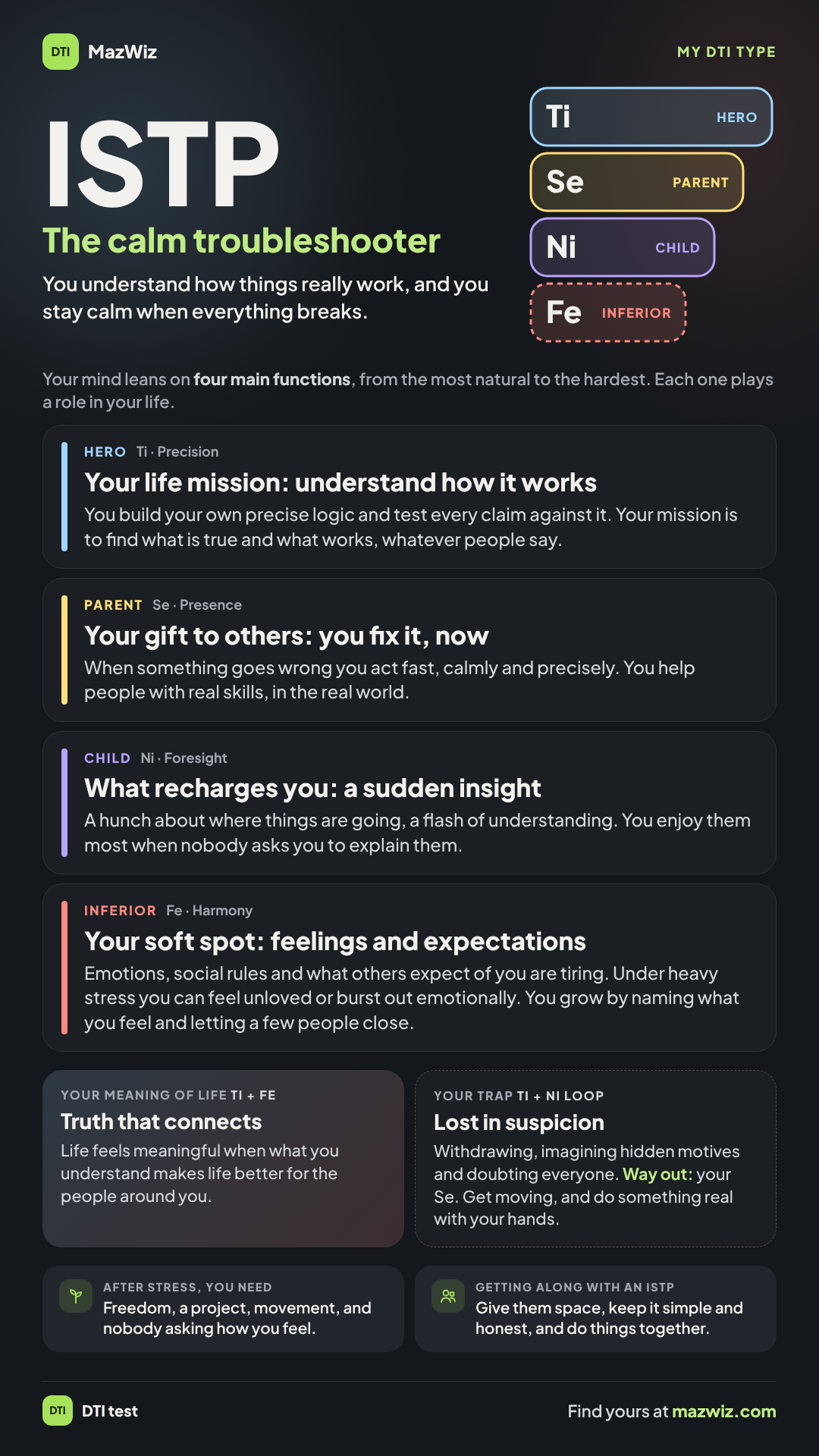
You understand how things really work, and you stay calm when everything breaks.
Hero Ti Precision
Your life mission: understand how it works
You build your own precise logic and test every claim against it. Your mission is to find what is true and what works, whatever people say.
Parent Se Presence
Your gift to others: you fix it, now
When something goes wrong you act fast, calmly and precisely. You help people with real skills, in the real world.
Child Ni Foresight
What recharges you: a sudden insight
A hunch about where things are going, a flash of understanding. You enjoy them most when nobody asks you to explain them.
Inferior Fe Harmony
Your soft spot: feelings and expectations
Emotions, social rules and what others expect of you are tiring. Under heavy stress you can feel unloved or burst out emotionally. You grow by naming what you feel and letting a few people close.
The meaning of life Ti + Fe
Truth that connects
Life feels meaningful when what you understand makes life better for the people around you.
The trap Ti + Ni loop
Lost in suspicion
Withdrawing, imagining hidden motives and doubting everyone. Way out: the Se Parent. Get moving, and do something real with your hands.
After stress, an ISTP needs
Freedom, a project, movement, and nobody asking how you feel.
Getting along with an ISTP
Give them space, keep it simple and honest, and do things together.
The texts of the DTI result page, addressed to an ISTP. Beebe
The eight seats
In the light
In the shadow
Each light function faces its shadow. Beebe's eight archetypes tells each seat's story. Beebe
The four sides of the mind
The four sides of the mind explains them. CS Joseph
How an ISTP shows
Talking
Concise analysis of what really matters: direct, to the point, no jargon and no fluff.
Solving problems
By finding the critical leverage point: the weak spot where one practical move fixes everything.
Under stress from
Rigid rules and theory with no use: red tape, constraints, being told how to do what they already understand.
The ISTP journey
1. The ordinary world Ti, Hero
Your home is how things really work. You take them apart, understand them, and fix them calmly when everything breaks.
2. The call Fe, Inferior
The call comes through Fe: people and their feelings. Someone needs you not to fix a problem but to be there, or a group asks you to belong.
5. The threshold Te, Opposing Personality
At the threshold stands Te: outside rules, procedures and managers who tell you how it must be done. Crossing means working with a system you did not design.
8. The ordeal Fi, Demon
At the bottom of the circle is Fi turned against you: hurt values and a cold sense that nobody can be trusted, yourself included. The ISTP's deepest fear is being betrayed, or of no worth to anyone.
The ally ESTJ, golden pair
Your golden pair, ESTJ, lives your shadow in the light. It organizes and plans, and shows you how your skill can serve something larger than the moment.
12. The return the gift
You come back with truth that connects: what you understand now makes life better for the people around you.
The same spine in a story: Stories decoded, the Ti story. MazWiz reading
What success means for an ISTP
Skill that serves people.
For an ISTP, success is mastering what you love, freely, and using it to make life better for the people around you.
The false summit. Total independence and perfect skill, with nobody close enough to share them.
The way there, seat by seat
- Ti Hero. Understand how it really works.
- Se Parent. Get your hands on it, and act.
- Ni Eternal Child. Trust the hunches that come to you.
- Fe Anima or Animus. Let people in, and show them you care.
To find your own definition
- What skill would you happily spend your life mastering?
- Who would you fix things for, if they asked?
- How do the people close to you know you care?
How to recognize an ISTP
The look
Relaxed and watchful, economical in movement, quiet until something interests them.
The words
Few and exact: "it depends", "let me look at it", "that will not hold".
The giveaway
While others discuss the problem, they have already taken it apart.
Often mistaken for INTP
Both lead with Ti. The ISTP's Parent is Se, hands and action; the INTP's is Ne, ideas and theories. Ask whether they take things apart with their hands, or in their head.
MazWiz readingPairs
Things that work, done right
ISTP understands how things really work and fixes them when they break; ESTJ organizes, plans and keeps them running. Together they make the world run smoothly.
The same two deciding functions, Ti and Fe, with the ways of perceiving turned around: each can teach the other.
Compare ISTP with any type in Pairs between types. CS Joseph